
In India’s regulated food ecosystem, product labeling is not just about branding—it is a legal obligation and a cornerstone of consumer protection. With growing consumer awareness, digital influence, and health consciousness, regulatory scrutiny on packaged goods has intensified. For any food business operator (FBO), navigating the labyrinth of labeling compliance is essential—not only to avoid penalties but also to build trust, ensure transparency, and maintain market credibility.

Image reference : www.petpooja.com
The Regulatory Landscape at a Glance
In India, food labeling and packaging regulations are governed by a combination of legal frameworks, primarily:
- FSSAI (Food Safety and Standards Authority of India) – for food safety, labeling, claims, and advertisements.
- Legal Metrology Act, 2009 – for weights, measures, MRP, and consumer protection.
- Consumer Protection Act, 2019 – for misleading claims and unfair trade practices.
- Advertising Standards Council of India (ASCI) – for voluntary but widely followed advertising guidelines.
Each body serves a unique purpose—but together, they establish a multi-tier compliance framework for product packaging and promotion.
1. FSSAI Labeling Regulations :
Authority: Food Safety and Standards Authority of India (FSSAI)
Law: Food Safety and Standards (Labelling and Display) Regulations, 2020
What It Covers:
FSSAI regulations govern all food products sold in India—whether manufactured locally or imported. They prescribe what information must appear on food labels, how it should be presented, and why it matters for the consumer.
Mandatory Label Elements:
Here’s what must be printed on any pre-packaged food:
- Name of the food – Describes the product accurately.
- Ingredients list – All components used, in descending order by weight/volume.
- Nutritional information – Per 100g or 100ml: energy (kcal), protein, carbs, sugar, fat, saturated & trans fats.
- FSSAI license number – Unique number linking the product to a registered entity.
- Allergen declaration – Identifies presence of allergens (gluten, milk, nuts, etc.).
- Veg/Non-veg logo – Green or brown dot as per dietary preference.
- Net quantity – Actual weight or volume.
- Date markings – Manufacturing date, expiry/best-before date.
- Manufacturer’s details – Name, address, and contact of the producer or marketer.
- Storage conditions – If applicable (e.g., “Keep refrigerated”).
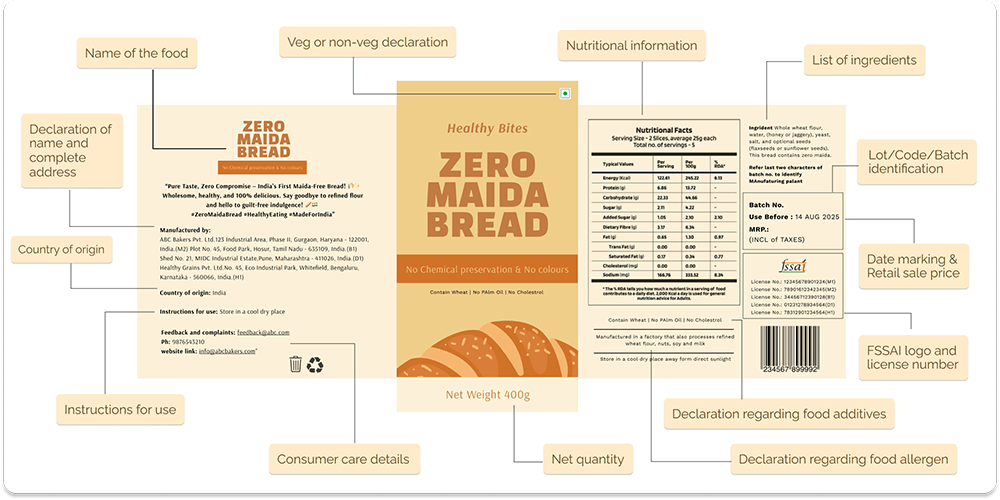
Image reference : www.esko.com
Why It’s Mandatory:
- Consumer Safety: Ensures customers know exactly what they are buying and consuming.
- Standardization: Creates uniformity across food labels, making comparison easier.
- Accountability: The FSSAI license number helps trace the manufacturer in case of health issues or legal action.
- Transparency: Ingredients, nutrition, and date info allow consumers to make informed choices.
Penalties:
Non-compliance can lead to:
- Product recall
- Suspension or cancellation of FSSAI license
- Fine up to ₹5 lakh
- Imprisonment in severe cases involving public harm
2. Display Advertisements (Print, Packaging, Online, etc.)
Authority: FSSAI + ASCI (Advertising Standards Council of India)
Law: FSSAI (Advertising and Claims) Regulations, 2018
What It Covers:
This regulation controls how food products are promoted through advertisements on packaging, TV, digital media, influencer content, and billboards.
What Is Not Allowed:
- Misleading visuals or text (e.g., showing ingredients that don’t exist in the product)
- Overstated benefits (“Cures diabetes”, “Burns fat instantly”)
- Use of unapproved terms like “organic”, “natural”, “fresh”, unless standards are met
- Ads targeting children that could encourage unhealthy behavior
What Is Allowed:
- Truthful claims backed by clinical or scientific data
- Use of terms like “low fat”, “sugar-free”, “enriched with calcium” only when FSSAI criteria are met
- Clear disclaimers when promoting non-standard claims
Why It’s Mandatory:
- Prevents consumer deception
- Protects public health from pseudo-scientific claims
- Ensures ethical marketing, especially when targeting sensitive groups like children or patients
Penalties:
- Removal of misleading advertisements
- Fines up to ₹10 lakh under the Consumer Protection Act
- Lawsuits, loss of brand credibility, and permanent damage to brand trust
3. Nutritional, Functional, and Health Claims
Authority: FSSAI
Law: Food Safety and Standards (Advertising and Claims) Regulations, 2018
What It Covers:
Any written, spoken, or visual statement on a label or ad claiming health or nutritional benefits.
Types of Claims:
| Type | Example | Requirements |
| Nutrient content | High in Vitamin C | Must meet FSSAI thresholds |
| Comparative | 50% less sugar than regular cookies | Must have measurable and provable comparison |
| Health claim | Boosts immunity | Needs scientific validation, may require disclaimer |
| Disease reduction | Helps lower blood pressure | Highly restricted and regulated |
Why It’s Mandatory:
- Builds consumer trust: People believe what’s on the label, so it must be backed by fact.
- Prevents unqualified health advice: Food products must not pretend to be medicine.
- Supports national nutrition policies: Aligns with public health initiatives like “Eat Right India”.
Penalties:
- Product ban or seizure
- Legal action for false advertising
- Public backlash, especially on social media

Image reference : www.foodlabelsolutions.com
4. Legal Metrology (Packaging Requirements)
Authority: Ministry of Consumer Affairs (Legal Metrology Division)
Law: Legal Metrology (Packaged Commodities) Rules, 2011
What It Covers:
This law ensures that all quantitative information on packaging is accurate and consistent.
Mandatory Declarations:
- Maximum Retail Price (MRP) – Inclusive of all taxes
- Net quantity – In standard weight (grams/kilograms) or volume (ml/liters)
- Manufacturing/import details – Including date and contact
- Batch number/lot number
- Country of origin – Especially important for imports
- Customer care contact – For complaints
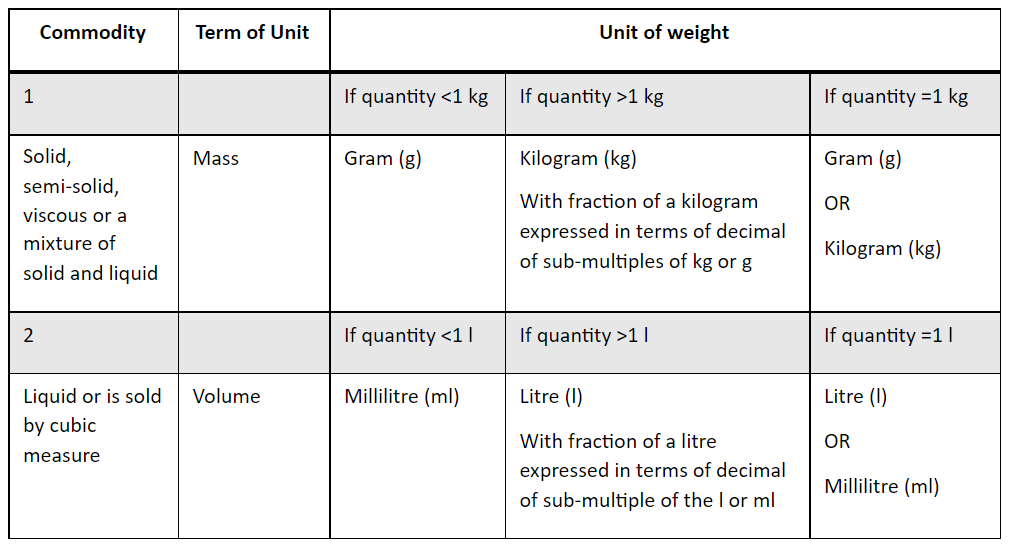
Image reference : www.foodlabelsolutions.com
Why It’s Mandatory:
- Fair trade: Protects consumers from overcharging or short-weighing.
- Market surveillance: Helps authorities conduct inspections and prevent fraud.
- Dispute resolution: Helps consumers and businesses trace packaging and address complaints.
Penalties:
- Fines up to ₹1 lakh
- Seizure of goods
- Business suspension for repeated non-compliance
Conclusion:
Complying with FSSAI labeling, advertising norms, claims regulations, and Legal Metrology rules is essential—not just for legal protection, but for building consumer trust and brand credibility. In a regulated and competitive market, accurate labeling and ethical promotion are key to long-term success.